If You’ve Been Told Cold Feet After 50 Are Just Aging, Bad Circulation, or “Running Cold” — A Board-Certified Vascular Physician Now Calls Them The Single Most Overlooked Early Warning Sign In Adult Medicine (And the American Heart Association Has Quietly Listed It For Years.)

If you’ve been sleeping in two pairs of socks since your forties —
If you’ve owned three different brands of compression socks and they only worked while you wore them —
If a doctor told you “some women just run cold” and to wear thicker layers —
Or if you’ve started telling yourself, this is just what 50 feels like —
Cold feet aren’t the problem. They’re the earliest warning sign of it.
According to vascular specialists, cold feet at 50 are not a comfort issue, not a personality trait, and not aging. They are the first measurable point on a four-stage progression that the American Heart Association has been listing in its warning literature for years — and that most women never see coming until they are at Stage 3 or 4.
“Cold feet at 50 is the single most overlooked early warning sign in vascular medicine. By the time a woman finally sits in front of me, she has usually been ignoring it for fifteen years.”1
Already recognize this pattern in your own routine?
Skip to the protocol ›The 2 AM ritual nearly every woman over 50 admits to
The pattern is consistent enough that vascular nurses can recite it.
You sleep in socks year-round. Two pairs in winter. One pair in July. You keep a throw at the foot of the bed even when the heat is on. You avoid the kitchen tile in the morning because you already know how cold it will feel. You hold your feet against your husband’s legs in bed and he flinches every single time. He runs warm. You don’t.
You have tried, in some order:
- Heated socks. Worked for an hour.
- Cashmere layered over cotton. Trapped heat that wasn’t getting there in the first place.
- A heating pad under the duvet. Warm while it ran. Cold by morning.
- Compression socks. Squeezed without restoring.
- Foot soaks in hot water before bed. Warm for ten minutes. Then back.
- Ginkgo, niacin, cayenne supplements. The bottle ran out before anything changed.
None of them held. Not because you weren’t trying. Because every single one of them addresses one stage of a four-stage failure — and the loop doesn’t open until three are hit at once.

What cold feet at 50 actually are: Stage 1 of Peripheral Cooling Syndrome
Cold feet are not a temperature problem. They are the visible end of four hidden failures, each one feeding the next:
1. The vessels narrow. The arteries feeding the toes are the smallest in the entire vascular tree and the furthest from the heart. They are also the first to slow with age.2
2. The calf pump weakens. Cardiologists call the calf muscles the “second heart” because they push blood back up the leg with every contraction. After 45, those muscles weaken. The pump fails quietly.
3. The blood pools. With narrow vessels and a weak pump, blood pools higher in the leg. The toes are last in line, so the toes feel it first.
4. The nerves go quiet. Starved of oxygen, the small-fiber nerves at the toes stop sending consistent signal. You stop feeling cold all the time. You start feeling nothing.
The American Heart Association lists “cold feet, especially in one foot” as one of the earliest warning signs of Peripheral Artery Disease — alongside leg cramps, slow-healing wounds, and skin discoloration. Most women never see that list. Their doctors rarely raise it during a routine visit.1
The four stages, and what each one looks like
Stage 1. Feet cool to the touch in the morning. Sleeping in socks year-round. Cold tile feels colder than it should. Most women dismiss this as personality. It is the window where reversal is simple.
Stage 2. Cold even under socks. Numbness when sitting still. Feet take longer to “wake up” in the morning. Still reversible. Most women miss this stage too.
Stage 3. Tingling at night. Restless legs. Mild swelling at the end of the day. Calf cramps that wake you at 3 AM. Skin on the lower leg starts to look slightly different.2 This is when most women finally bring it up to a doctor. Most are told to monitor it.
Stage 4. Persistent numbness. Slow-healing cuts and bruises on the feet. Skin discoloration. In severe cases — non-healing wounds and the limb-threatening complications listed in every American Heart Association PAD guideline. By Stage 4, this is no longer a comfort problem.
“The thing that haunts me about cold feet is the math. The treatment at Stage 1 is simple, cheap, and home-based. The treatment at Stage 4 involves a vascular surgeon. The cost of waiting is not a few extra winters of cold feet. It is a fifteen-year window that closes quietly.”
This is also why every product in the typical cold-feet drawer scores so poorly when measured against the four-stage loop:
None of them are wrong. They all do something real. They all address one quarter of the problem.
If your own score on this table is 1 of 4 across every product in your drawer — here’s the protocol that hits three at once.
Skip to the protocol ›The protocol that opens the loop — clinicians call it Hemodynamic Therapy
The reversal protocol is not new. Research groups at Mayo Clinic, Cleveland Clinic, Johns Hopkins, and the American Heart Association3 have published on it for decades. Vascular nurses call it “Hemodynamic Therapy.”
It is three things, delivered in the same fifteen-minute session:
1. Targeted heat (104–107°F). Dilates the narrowed peripheral vessels feeding the foot. Restores the pathway warm blood needs to actually reach the toes.
2. Rhythmic compression. Pushes the pooled blood back through the lower leg. Replaces the calf pump that has weakened.
3. Low-level neuromuscular activation. Gentle electrical pulses reactivate the calf and intrinsic foot muscles. The “second heart” comes back online — and the small-fiber nerves that had stopped sending signal start receiving it again.
“One alone doesn’t work. Two doesn’t. Three at once is the threshold. The fourth stage — the silent nerves — quiets back to normal on its own. Because nothing is starving them anymore.”
Until recently, you could only get all three together inside a vascular clinic. Two to three visits a week. $150 to $250 per session. Plus the insurance pre-approvals that most plans declined for “cold feet” alone — only for diagnosed peripheral arterial disease, by which point the patient was already at Stage 3 or 4.
That is what has changed in the last 18 months.
The at-home Hemodynamic Therapy device: Soleus Foot Therapy System
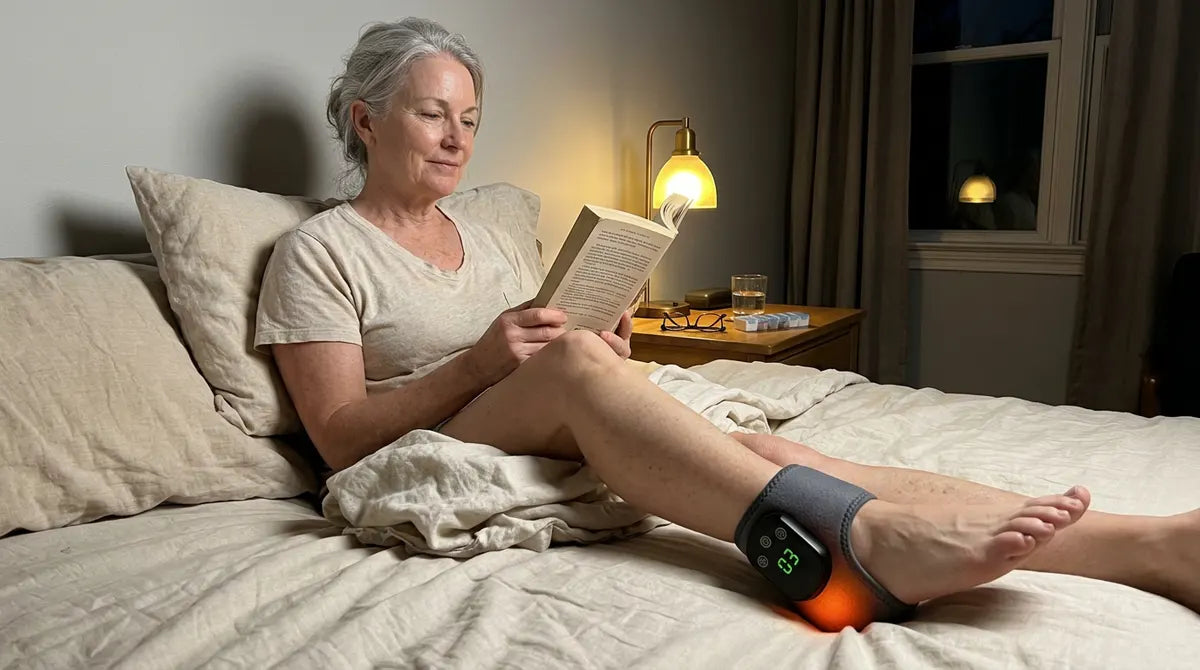
The device readers have written in about most is called the Soleus Foot Therapy System. It is a soft neoprene wrap that delivers all three parts of Hemodynamic Therapy — targeted heat, rhythmic compression, and low-level neuromuscular activation — in a single 15-minute session.
No clinic. No appointment. No driving. You sit on the couch.
- Wrap it around your foot, press one button, run for 15 minutes
- All three Hemodynamic Therapy modalities run together — three stages of the loop, hit at once
- Cordless and rechargeable — use it in bed, on the couch, anywhere at home
It is not a prescription device. It is a wellness product built around the same three-part combination clinic sessions use. Whether it is right for you depends on your situation. But if you have been cycling through single-stage products — thicker socks, heating pads, compression sleeves, supplements — it is at least worth reading the details.
See the reader rate ›What women who’ve used it are reporting
“I’ve been sleeping in two pairs of socks since I was 48. I am 61 now. After three weeks of using this for fifteen minutes before bed I am sleeping in one thin pair, and most nights I kick those off too. I almost did not buy it. The thing that convinced me was the three-therapy explanation — it was the first time anyone had told me why the heating pad alone never fixed it.”
“My husband noticed before I did. He said my feet did not feel like ice cubes when I got into bed anymore. I had not realized I was warmer because I was so used to being cold. I used it every night for a month. Now I use it three or four times a week to maintain.”
“I’m a retired nurse. I knew about EMS, I knew about compression, I had a heating pad, I had a TENS unit. I had every piece separately. The reason this works and those did not is the sequence — all three together for fifteen minutes is not the same as any one of them for an hour.”
*Testimonials reflect the experiences of individual users. Individual results may vary.
The takeaway
Cold feet at 50 are not the problem. They are the earliest, quietest, most reversible symptom of the problem.
The reason most women never see Stage 4 coming is that nobody told them Stage 1 was Stage 1.
Whether the at-home device, a clinic program, or some combination — the window to reverse it is at Stage 1 and 2. That window closes quietly, on a fifteen-year clock most women never see.
If you have been told it is just aging, just running cold, just what 50 feels like — the AHA list says otherwise. So does Mayo. So does Cleveland Clinic. So does the woman whose feet finally felt warm in bed last week for the first time in a decade.
References
- American Heart Association — “Symptoms and Diagnosis of PAD.”
- Cleveland Clinic — “Peripheral Artery Disease (PAD): Symptoms, Causes & Treatment.”
- Mayo Clinic — “Peripheral Artery Disease: Symptoms and Causes.”
- American Heart Association — “Peripheral Artery Disease” (overview).
- Johns Hopkins Medicine — “Peripheral Vascular Disease.”