Cardiologists Quietly Call These 4 Things In Your Feet “The Canary” — (And Most Annual Physicals Never Check For Them)

A reader wrote in last month with a question we couldn’t stop thinking about. “Why did my GP say my circulation was fine for ten years — and then a vascular specialist took one look at my feet and said something completely different?”
Cholesterol panel: normal. Blood pressure: normal. EKG: normal. Annual physical for a decade. Then she finally went to a vascular specialist for the cold feet she’d been calling “just aging.” He took off her socks. He pointed at four things. And he said something her GP had never said.
So we reached out to two specialists. They work on different parts of the same problem.
Dr. Helen Marsh — a board-certified vascular medicine specialist with 19 years in clinical practice. And a consulted preventive cardiology physician whose work focuses on early indicators of arterial decline. She asked not to be named while this article was being prepared.
“Peripheral circulation is one of the most underdiscussed parts of vascular aging,”1 Dr. Marsh says. “Cardiologists watch for it. Most primary-care physicals don’t.”
“The signs are visible. They’re cheap to check. And they show up earlier than almost any test we run on the heart,” the cardiologist adds. “Some of my colleagues call them the canary in the coal mine.”
We asked both specialists the same question: what are the 4 visible signs in the feet that vascular medicine watches for — and why don’t most patients know about them?
Their answer surprised us. The signs are simple. They’re sitting in your shoes right now. And almost no one is told to look for them.
3 facts about peripheral circulation that explain why your physical missed it
Both experts started with the science.
Fact #1: The arteries in your feet are smaller — and they narrow first
“Your peripheral arteries — the small ones that feed your feet and lower legs — are physically smaller in diameter than the arteries in your chest,”2 Dr. Marsh explains. “That means they show plaque, narrowing, and reduced flow years before the larger central arteries do.”
That matters. By the time a stress test, calcium score, or EKG flags a problem in the chest, the small vessels have been telling that story for five to ten years. The feet are the early warning system.
Fact #2: When the small vessels narrow, your feet show it 4 specific ways
“This is the part nobody explains to patients,” Dr. Marsh says. “When peripheral blood flow declines, you don’t feel it as ‘chest tightness’ or ‘shortness of breath.’ You feel it as four small things. Most people dismiss every one of them.”
The four signs:
1. Cold tips. Toes that stay cold long after the rest of you warms up. The tissue isn’t getting enough warm blood to keep the skin temperature even.
2. Tingling or numbness. Pins-and-needles sensations along the top of the foot or in the toes — especially first thing in the morning or after sitting still.
3. Slow-healing skin. A small cut, callus, or blister on the foot that takes weeks instead of days to close. The tissue isn’t being fed the supplies it needs to repair itself.
4. Pale toenail beds. The pink color under the nails fades to a chalky white or slight bluish cast. That’s reduced capillary fill in the smallest vessels of all.
“Each one alone seems trivial,” the cardiologist says. “Together, they’re a pattern. And the pattern is what we mean when we say canary.”
Fact #3: You can’t restore peripheral circulation one symptom at a time
“Here’s the part that changes everything,” Dr. Marsh says.
“Peripheral circulation isn’t a single problem. It’s a four-point loop in your lower limbs. Narrowed small arteries. Stiffened calf muscles that stop pumping blood back up the leg. Reduced capillary flow in the foot tissue. And static, pooled blood that sits and doesn’t move.”
Every single-point fix — compression socks alone, walking alone, foot soaks alone — addresses one of those four points. The other three keep the loop closed.
“You can’t retrain peripheral circulation by squeezing the leg, or warming the foot, or pumping the calf in isolation. The vessels need all four inputs at once. That’s the threshold. That’s why one therapy at a time hasn’t worked for the patients I see.”
Already noticed any of the four signs in your own feet?
Skip to the protocol ›Score every common “circulation” remedy against the 4-point loop
We asked Dr. Marsh to walk us through the most common things patients try when they notice cold feet, tingling, or other early circulation signs. One by one. Which point of the four-point peripheral loop does each one actually address?
The pattern was striking.

“None of these are wrong,” Dr. Marsh said when we showed her the table. “Every one of them is doing something real. But peripheral circulation aging doesn’t reverse with a one-point input. You can see the math right here.”
“The question isn’t ‘what’s the best single thing for cold feet.’ It’s ‘what hits all four points of the peripheral loop in the same session.’ That’s a different question. And almost no patient has been asked it.”
If your own score across every remedy you’ve tried would be 1 of 4 — here’s the at-home protocol that hits all four at once.
Skip to the protocol ›The four therapies that open the peripheral loop — clinicians call it “Hemodynamic Therapy”
“The research on lower-limb circulation has been clear for more than two decades,” Dr. Marsh says. “Four interventions, delivered in the same session, are what it takes to retrain the small vessels and the muscles that pump them.”
She gave us the name vascular clinicians use for it informally: Hemodynamic Therapy.
It’s four things, at once:
1. Targeted heat (104–107°F). Opens the small peripheral arteries that feed the foot. The supply line the tissue has been losing.
2. Rhythmic compression. Squeezes the line so blood actually moves. Because the foot has no muscle pump of its own at rest, you have to give it one.
3. Low-level neuromuscular activation (EMS). Gentle electrical pulses contract the calf and foot muscles — the “second heart” that pumps blood back up the leg toward the body.
4. Vibration. Breaks up static, pooled flow in the smallest vessels — the kind that lets toenail beds go pale and skin go thin.
“One alone doesn’t work. Two doesn’t. Three is closer. Four at once is the threshold. The vessels respond to the combination, not to any single input,” Dr. Marsh says.
Hemodynamic Therapy — all four modalities, delivered in a single 15-minute at-home session.
Skip to the protocol ›What the research community has published — and why this is finally reaching patients
The four-modality combination isn’t new in vascular research.
Research groups at institutions like Mayo Clinic, Cleveland Clinic, and the American Heart Association have published extensively on multimodal peripheral circulation interventions over the past decade. They’ve documented how heat, compression, neuromuscular stimulation, and mechanical agitation work together to restore blood flow and capillary fill in the lower limbs.3
Until recently, though, you could only get all four together in a vascular clinic.
Two to three visits a week. $150 to $250 per session. Plus the insurance pre-approvals that most patients never cleared — because peripheral circulation aging without acute disease doesn’t qualify under most plans.
“Most of my patients couldn’t do that — financially, logistically, or because the foot that was already cold and tingling was the same foot they’d need to drive with,” Dr. Marsh says. “So they settled for one therapy at a time. Which is exactly why the loop never opened.”
That has started to change.
Over the last 18 months, a small number of companies have commercialized Hemodynamic Therapy for at-home use — designed around the same four-modality combination clinicians have been using for years. One of them agreed to offer our FootHealth.Life readers a direct rate, without the typical clinic markup.
A reader-secured direct rate: the Soleus Foot Therapy System
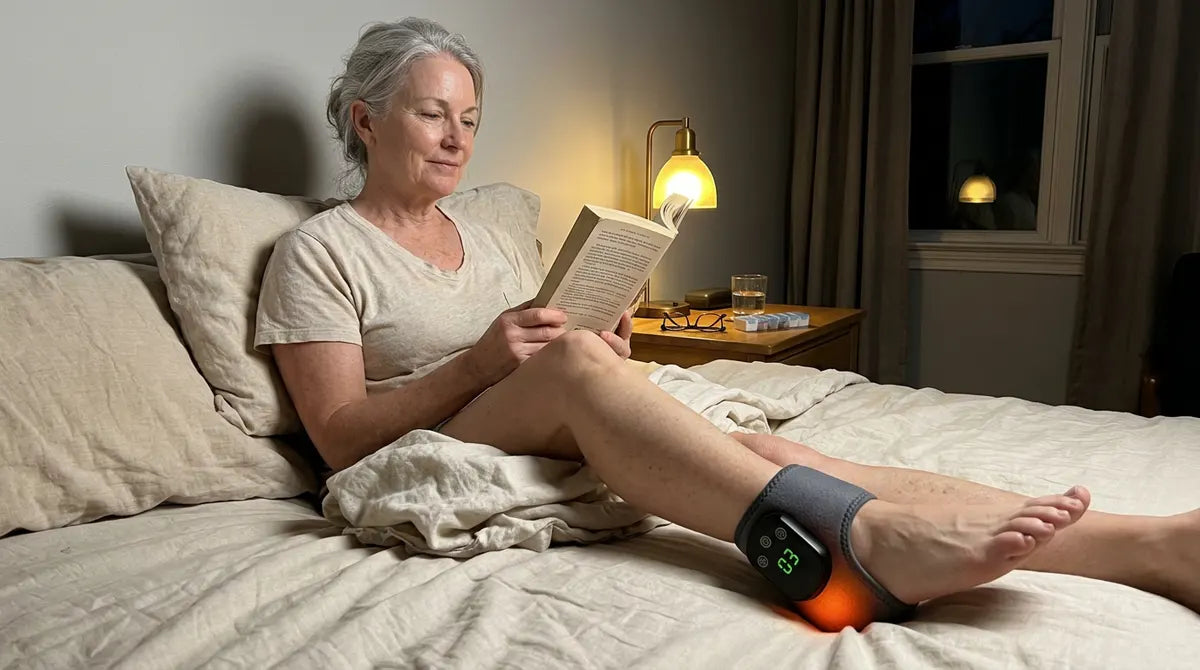
The device FootHealth.Life readers have written in about most is called the Soleus Foot Therapy System. It’s a simple neoprene wrap that delivers all four parts of Hemodynamic Therapy — targeted heat, rhythmic compression, low-level neuromuscular activation, and vibration — in one 15-minute session.
No clinic. No appointment. No driving. You sit on the couch.
- Strap it around your foot, press one button, run for 15 minutes
- All four Hemodynamic Therapy modalities run together in the same session
- Cordless and rechargeable — use it anywhere at home
One important note from us, and from Dr. Marsh: the Soleus Foot Therapy System is a peripheral circulation device for your legs and feet. It is not a heart device. Nobody — not us, not Dr. Marsh, not the cardiologist we consulted — can tell you what it does or doesn’t do for your central cardiovascular system. What we can tell you is what it’s built to do: deliver four therapies that the research links to peripheral circulation. Anything beyond that is between you and your physician.
See the reader rate ›What patients who’ve used it are reporting
“My GP said my cold feet were just aging. For three years I slept in wool socks. Two weeks in I forgot to put them on one night and didn’t wake up cold. By week six the cut on my second toe that wouldn’t heal for two months had finally closed. I’m not going to call it a miracle. I’m going to call it the first thing that ever changed any of the four signs.”
“Father died at 67. Uncle at 62. I had every cardiac test on the menu and they all came back ‘normal.’ Then a vascular specialist took one look at my toes — pale tips, slow-healing scrape on the third toe — and said something my GP never had. I bought the Soleus that week. About three weeks in my wife asked when my toes had stopped looking gray. I hadn’t noticed.”
“The tingling in my left foot used to wake me up at 3 a.m. Compression socks helped at the surface. They didn’t help underneath. I use this for fifteen minutes before bed. The 3 a.m. tingling is the thing my husband noticed first — he said ‘you’re sleeping through the night again.’ I hadn’t realized I’d stopped.”
*Testimonials reflect the experiences of individual users. Individual results may vary. These are not guaranteed outcomes and are not intended as medical advice. The Soleus Foot Therapy System addresses peripheral circulation only and makes no claims regarding cardiac or cardiovascular disease prevention.

The takeaway
Both specialists we spoke with landed on the same point.
Peripheral circulation aging doesn’t fail to reverse because patients haven’t tried hard enough. It fails because it’s a four-point loop. Single-point remedies — no matter how good — can’t hold that loop open long enough for the small vessels to retrain.
“If you’ve been noticing any of the four signs — cold tips, tingling, slow-healing skin, pale toenails — I’d encourage you to look at options that hit all four points of the peripheral loop at once,” Dr. Marsh said at the end of our call. “Not because any device is a guarantee. And not as a substitute for the cardiac care your physician recommends. But because the math of the loop is real, and the canary is real, and most physicals don’t check.”
Whether it’s a clinic program, an at-home device like Soleus, or something else — the category is what matters.
The era of “your cold feet are just aging” may finally be ending. Not because the remedies got better. Because we finally started counting how many points of the peripheral loop we were addressing at once.
References
- Mayo Clinic — “Peripheral Artery Disease (PAD): Symptoms and Causes.”
- American Heart Association — “Peripheral Artery Disease (PAD): Overview.”
- American Heart Association — “Treatment of PAD: Lifestyle Changes and Medical Care.”
- Cleveland Clinic — “Peripheral Artery Disease: Symptoms, Causes & Treatment.”