Ice Is Why Your Plantar Fasciitis Hasn’t Healed.

You probably have a frozen water bottle in your freezer right now. You roll your foot on it every morning. Your doctor told you to. The doctor who started that advice in 1978 took it back in 2014. Most foot doctors never told their patients.
You’ve been told it would help. You’ve done it every day for years. And your heel still hurts the second you stand up.
So we asked two experts. Dr. James Caldwell is a foot doctor with 22 years of work.2 The other is a blood-flow researcher. She studies how blood reaches the tough tissue in your feet. She asked us not to use her name while we wrote this.
Both said the same thing. “Plantar fasciitis is one of the hardest things we treat. For most people, it doesn’t go away. It just keeps coming back.”
So we asked: why does it come back? And why don’t patients ever hear the real reason?
The 2014 fix your doctor never told you about
In 1978, a doctor named Gabe Mirkin made up a famous rule. He called it RICE. It stood for Rest, Ice, Compression, Elevation. Almost every doctor and coach in America has used it for 46 years.
In 2014, Dr. Mirkin took back the “I” part. Ice. He said he was wrong.
“Coaches have used my RICE rule for years. But now it looks like ice and full rest can actually slow down healing.”1
You can read his full statement on his website (drmirkin.com). It’s been online for over 10 years. Most foot doctors are still teaching the 1978 version.
Why ice makes plantar fasciitis worse
To see why ice is wrong for your foot, you need one fact about your body.
The tissue under your foot barely has any blood in it.
That tissue is called your plantar fascia. It’s a thick rope-like band that runs across the bottom of your foot. It’s tough and stretchy. But it has almost no blood tubes running through it.
That matters because your body heals with blood. When you cut your hand, blood rushes to the cut. The blood brings the stuff that fixes the damage. When you hurt your plantar fascia, your body sends help. But there’s no road for the help to drive in on.
Now here’s what ice does. Cold makes blood tubes shrink. The tiny tubes that carry blood get smaller. Less blood gets through.
For a fresh sprain, that’s okay. Less blood means less swelling. That’s why people put ice on a twisted ankle right away. That’s the kind of hurt the 1978 rule was made for.
But your plantar fasciitis is not fresh. It’s been there for months or years. And the tissue already had hardly any blood to start with. Ice shrinks the little bit of blood flow that was left.
Your foot feels numb. That feels like it helps. But underneath, the tissue is getting even less of what it needs to heal.
Five minutes of numb. Years of foot pain that won’t go away.

Ice is only one of four problems
If ice were the only thing wrong, you could throw out the frozen bottle today. Your foot would heal by next week.
It won’t. Ask anyone who has tried.
Here’s why. Ice is only one of four things your body has locked up around the hurt area. Stop the ice and you fix one. The other three still hold the lock shut.
Dr. Caldwell and the blood-flow researcher call it the 4-Point Tissue Lock.
Lock #1 — Your nerves send a pain signal
The hurt sends a pain signal up your leg. Your brain hears it all day. The signal never stops.
Lock #2 — Your muscles tighten up to protect the area
When something hurts, your body squeezes the muscles around it. You don’t choose this. Your nerves do it for you.
“When your foot hurts, your body tightens the muscles around it. Those tight muscles squeeze the blood tubes even more. The tissue that was already short on blood now gets even less.”
Lock #3 — Tight muscles cut off blood flow
Tight muscles squeeze the blood tubes next to them. The tissue gets even less blood than before. And it didn’t have much to start with.
Lock #4 — The tissue starves
Without enough blood, the tissue can’t heal. The damage stays. The pain stays. The nerves keep firing. The muscles stay tight. The lock stays shut.
“You can’t open a 4-pin lock one pin at a time. But that’s what we’ve been asking patients to do for 20 years. Try one thing. Then another. Then another. The lock never opens unless you hit three pins at once.”
If this sounds like your past 5 or 10 years — read the next part.
Jump to the solution ›Look at every treatment you’ve tried
We asked Dr. Caldwell to score every common plantar fasciitis treatment. How many of the four locks does each one open?
Here’s what he wrote down.

Look at the math. Most treatments open only one lock. Icing opens zero — it actually makes the blood flow problem worse. No wonder it never worked.
“I’ve changed how I talk to my patients. The question isn’t ‘which treatment is best.’ It’s ‘which one opens more than one lock at the same time?’ That’s a different question. And only that one has a useful answer.”
If you score 1 of 4 across every treatment you’ve tried — here’s the at-home plan that opens three locks at once.
Jump to the solution ›What actually opens the lock
The blood-flow researcher gave us the short version.
Three things have to happen at the same time. In one session.
1. Warm the foot. Heat at 104 to 107 degrees. That exact range opens the small blood tubes. The blood supply finally reaches the hurt tissue.
2. Gentle squeezing pumps the blood through. Your foot doesn’t have its own pump. You have to give it one. Soft rhythm pumps push the warm blood into the tissue.
3. Tiny pulses wake up the tight muscles. Small electric pulses you can barely feel. They relax the muscles that have been squeezing your blood tubes for years.
“One alone doesn’t work. Two doesn’t work. Three at once is the line. The pain signal — that’s the fourth lock — quiets down on its own. Because nothing is holding it active anymore.”
The full name is Hemodynamic Therapy. That’s a fancy way to say “moving blood through the tissue.” Until recently, you could only get it in a clinic.
All three therapies in one 20-minute at-home session.
Jump to the solution ›Big hospitals have known this for years
Research from Mayo Clinic, Johns Hopkins, and the American College of Sports Medicine has shown this for over 10 years. Heat plus squeezing plus tiny pulses, all at once, helps tough tissue heal. They’ve all published papers on it.
The catch: you could only get all three in a clinic. Two or three visits a week. $150 to $250 per visit. Insurance often said no.
“Most of my patients can’t do that,” Dr. Caldwell said. “Cost. Time. The foot that hurts is the same foot they have to drive with. So they pick one therapy at a time. That’s why their pain never goes away.”
That’s starting to change. A few companies have made the same three-part treatment work at home. One agreed to give our readers a direct rate, without the clinic markup.
The Soleus Foot Therapy System — at home, all three at once
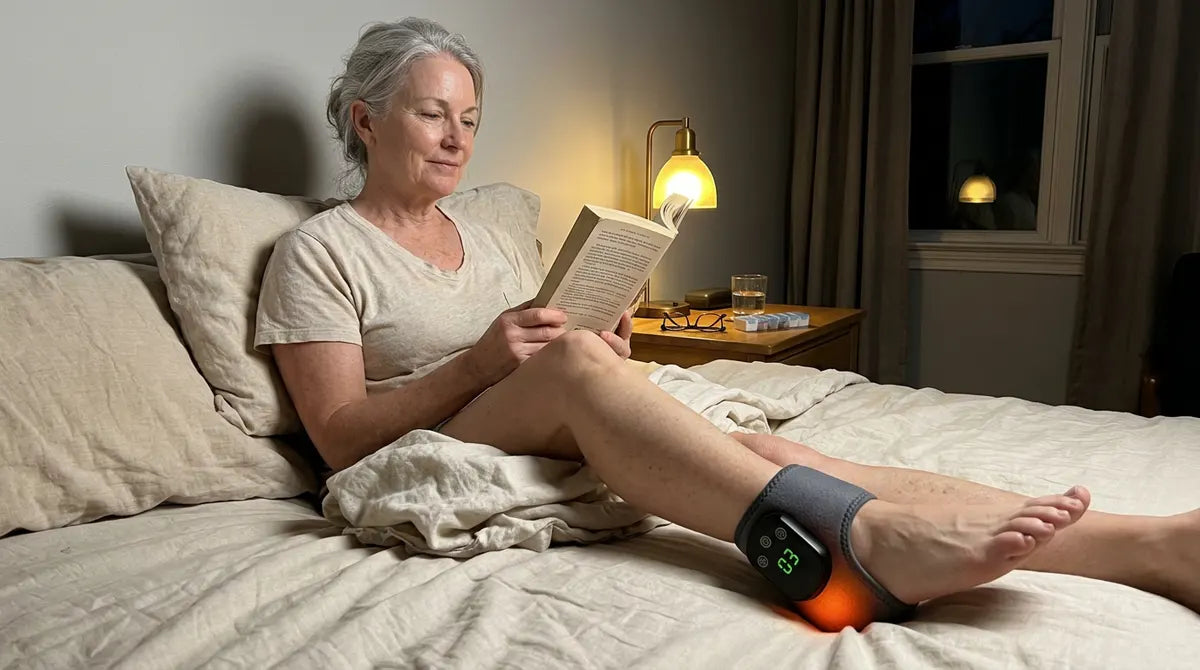
Our readers ask about this one most. It’s called the Soleus Foot Therapy System. A simple wrap made of soft material. Strap it on your foot. Press one button. Sit for 20 minutes. All three therapies run together.
No clinic. No appointment. No driving. You sit on your couch.
- Strap it on your foot, press one button, run for 20 minutes
- All three therapies run at the same time, in the same session
- No cord. Rechargeable. Use anywhere at home
It’s not a prescription. It’s a wellness product. Whether it’s right for you depends on your case. But if you’ve been trying one thing at a time for years — it’s worth knowing about.
See the reader rate ›What people are saying after they tried it
“Three doctors told me I just had to live with it. I spent five years and over six thousand dollars trying to prove them wrong. After two weeks of using it, I stopped grabbing the bathroom counter every morning. Last Saturday I walked the farmers market for two hours. I kept waiting for the pain to come back. It didn’t.”
“I had two cortisone shots this year. My doctor said no more. I thought I was out of options. My daughter pushed me to try this. Three weeks in, my husband saw it before I did. He said ‘you used to flinch when you stood up.’ I hadn’t noticed I’d stopped.”
“I’m a nurse. I’m on my feet all day. I tried PT, orthotics, the night splint. None of it held. This is the first thing that actually changed my mornings. I use it while I watch the news before bed. The simplest thing I’ve tried.”
*Customer stories show what happened for those people. Your results may be different. This is not medical advice.

What this all means
Both experts said the same thing at the end.
Plantar fasciitis doesn’t stick around because you didn’t try hard enough. It sticks around because it’s a 4-pin lock. One-pin treatments — no matter how good — can’t hold the lock open long enough for your foot to heal.
“If you’ve been stuck in the cycle, look at treatments that open more than one lock at once,” Dr. Caldwell said. “Not because any one product is a guarantee. But because the math is real.”
Whether it’s a clinic, an at-home device like Soleus, or something else — the type of treatment matters.
The days of “just live with it” may finally be ending. Not because the treatments got better. Because we finally started counting how many locks we were opening at once.
References
- Mirkin G. (2014). “Why Ice Delays Recovery.” drmirkin.com — the doctor who started RICE in 1978 takes back the ice part.
- American Academy of Orthopaedic Surgeons — “Plantar Fasciitis and Bone Spurs” (OrthoInfo).
- Martin R.L. et al. — “Heel Pain — Plantar Fasciitis: Revision 2014.” Journal of Orthopaedic & Sports Physical Therapy Clinical Practice Guideline.
- Cleveland Clinic — “Plantar Fasciitis: Symptoms, Causes & Treatment.”
- Mayo Clinic — “Plantar Fasciitis: Symptoms and Causes.”