If You’ve Been Told It’s Plantar Fasciitis, Tired Feet, or “Just Getting Older” — Here’s What 22 Years in Podiatry Reveals Most Doctors Never Check (Hint: it’s not your shoes. It’s not your stretches. It’s not your age.)

If you’ve spent four-figure money on “doctor-recommended” walking shoes —
If you’ve stretched every morning for a year and the pain keeps coming back —
If a doctor told you it’s “just plantar fasciitis” and to keep doing what you’re doing —
Or if you’ve started telling yourself, this is just what 50 feels like —
You’ve been treating the wrong problem.
Not because you weren’t trying. Not because your shoes are bad. Not because your stretches are wrong. Not because of your age.
Because every single one of those things treats one point of a four-point loop. And the loop doesn’t open until three of the four are hit in the same session.
This isn’t a stretch tip. It isn’t a new sneaker. It’s the part most exam rooms never explain — and it’s the reason your foot pain keeps cycling back three weeks after every treatment.
Already recognize this pattern in your own treatment history?
Skip to the solution ›We reached out to two specialists who’ve spent their careers on opposite sides of this problem.
Dr. James Caldwell, DPM — a board-certified podiatrist with 22 years in practice. And a vascular medicine researcher whose lab studies how blood reaches connective tissue. She asked not to be named while this article was being prepared.
“For a lot of patients, the foot pain doesn’t really go away. It just cycles.”1
“Most patients spend thousands of dollars chasing the pain instead of the cause.”
We asked both specialists the same question: what do clinicians actually know about why foot pain keeps coming back — and why hasn’t that reached patients?
Their answer surprised us. It’s a pattern almost no exam room ever explains. And once you see it, every failed treatment in your past makes sense.
3 facts that explain why every treatment you’ve tried only worked for a few weeks
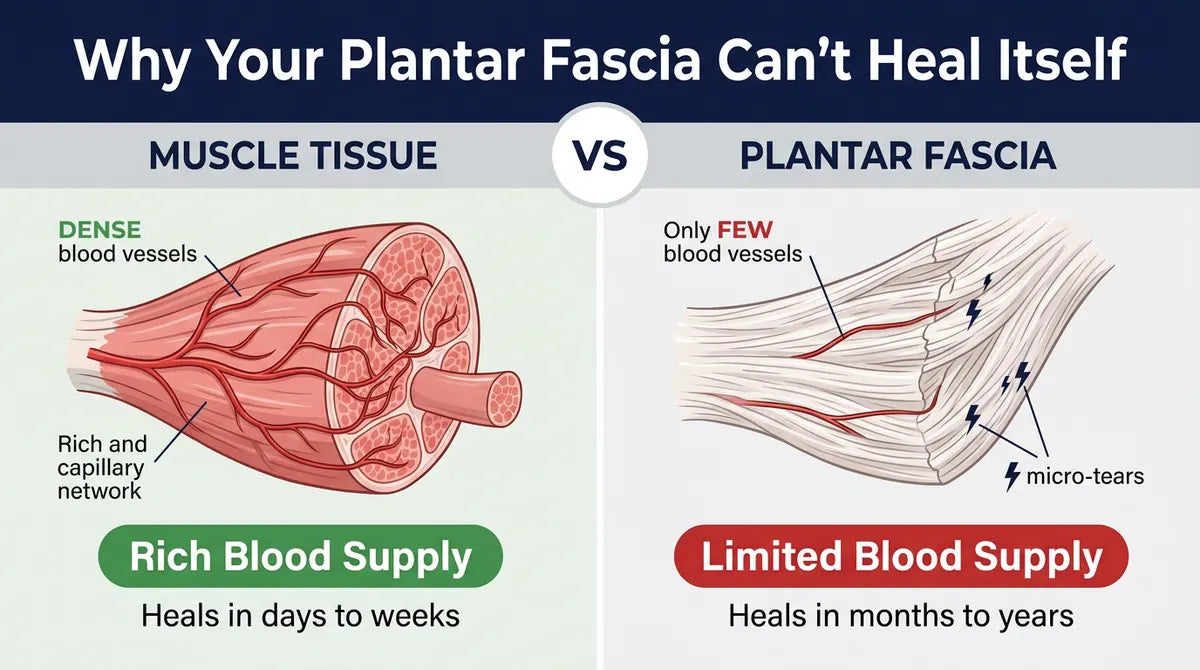
Fact #1: Your fascia has almost no blood flow of its own
“The plantar fascia is a thick band of tissue. It’s dense. And it has barely any blood vessels running through it,”2 the researcher explains. “When a muscle gets damaged, your body sends blood to heal it. Your fascia doesn’t have that supply line.”
That’s why a condition that “looks simple on an MRI” is so hard to actually fix. The tissue can’t repair at normal speed. Small damage piles up faster than it can heal.
This is also why your skin can be aging just fine while your fascia is starving. Different tissue. Different blood supply. Different problem.
Fact #2: Your own body is blocking the healing it’s trying to protect
“This is the part almost nobody explains,” Dr. Caldwell says. “When your fascia hurts, your body tightens the muscles around it to protect the area.”
“You don’t choose this. Your nervous system does it for you. And the problem is: those tight muscles squeeze the blood vessels even more. The tissue that was already starved gets even less.”
So your body’s own protection response is choking the supply the tissue needs to heal.
This is why stretching alone has never been enough. Stretching loosens the muscle. It doesn’t restore the blood flow that was already insufficient before the muscle ever tightened up.
Fact #3: You can’t pick a four-point loop one point at a time
“Here’s the part that changes everything,” the researcher says.
“Plantar fasciitis isn’t a single injury. It’s a four-point loop. Pain signal. Muscle guarding. Blocked blood flow. Starved tissue. Each one keeps the other three in place.”
Every treatment you’ve ever tried breaks exactly one of those four points. The other three put the loop right back within hours.
“You can’t pick a four-pin lock one pin at a time. For twenty years, that’s what we’ve been asking patients to do. Try one thing. Then the next thing. Then the next. The loop doesn’t open until you hit three points in the same session.”
Already recognize this pattern in your own treatment history?
Skip to the solution ›Score every treatment you’ve ever tried against the 4-point loop
We asked Dr. Caldwell to walk us through the most common foot-pain treatments. One by one. Which point of the loop does each one actually break?
The pattern was striking.
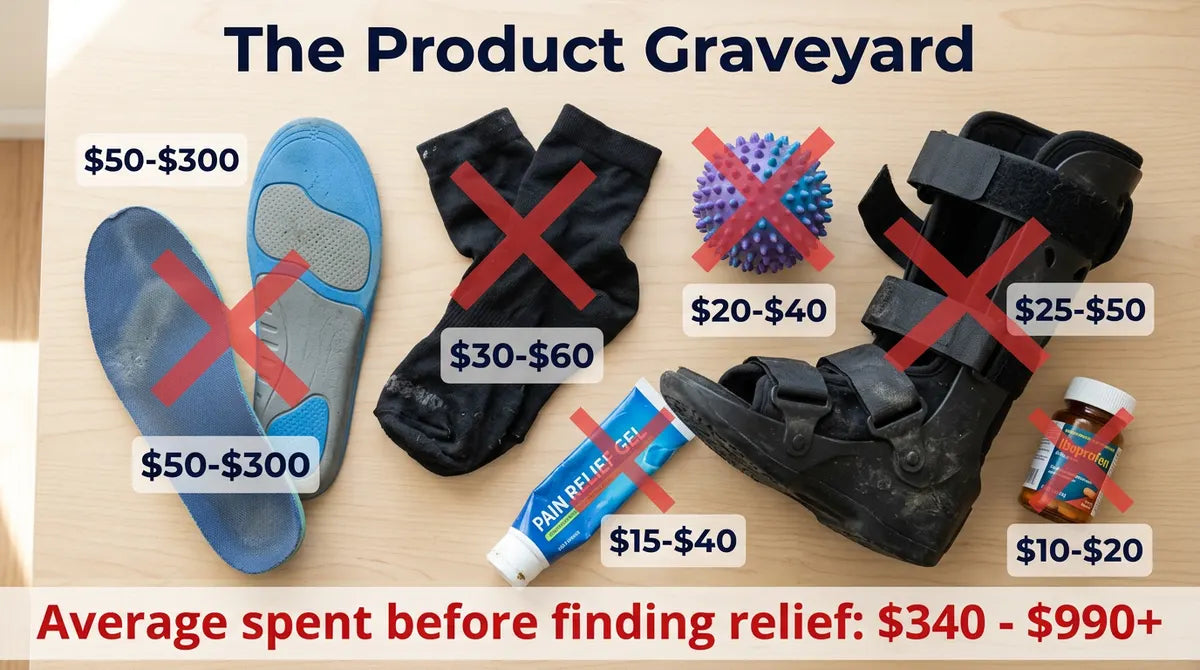
“None of these are wrong,” Dr. Caldwell said when we showed him the table. “They all do something real. But a four-point loop doesn’t open with a one-point fix. You can see the math right here.”
“This is why I’ve changed how I talk to patients. The question isn’t ‘which treatment is best.’ It’s ‘which combination hits multiple points of the loop in the same session.’ Those are very different questions. And only one of them has a useful answer.”
If your own score would be 1 of 4 across every treatment you’ve tried — here’s the at-home protocol that hits three points at once.
Skip to the solution ›The three therapies that open the loop — clinicians call it “Hemodynamic Therapy”
“The research on fascia recovery has been clear for more than twenty years,” the researcher says. “Three treatments, delivered in the same session, are what it takes to hold the loop open long enough for the tissue to start repairing.”
She gave us the name clinicians use for it informally: Hemodynamic Therapy.
It’s three things, at once:
1. Targeted heat (104–107°F). Opens the small blood vessels that feed the fascia. The supply line the tissue has been starved of.
2. Rhythmic compression. Pumps blood through the tissue. Because the fascia has no muscle pump of its own, you have to give it one.
3. Low-level neuromuscular activation. Gentle electrical pulses release the tight, guarding muscles. So they stop squeezing the blood vessels shut.
“One alone doesn’t work. Two doesn’t. Three at once is the threshold. The fourth point — the pain signal — quiets on its own. Because nothing is holding it active anymore,” the researcher says.
This is the moment most patients we’ve spoken to had a “so that’s why nothing has worked” reaction. Three weeks of relief from a cortisone shot. A month from shockwave. A year from a custom orthotic. None of them held — because none of them ever opened more than one point of the loop.
Hemodynamic Therapy — all three therapies, delivered in a single 20-minute at-home session.
Skip to the solution ›What Mayo Clinic, Johns Hopkins, and others have published — and why this is finally reaching patients
The three-therapy combination isn’t new in the research world.
Research groups at institutions like Mayo Clinic, Johns Hopkins, and the American College of Sports Medicine have published extensively on multimodal soft-tissue recovery over the past decade. They’ve documented how heat, compression, and electrical stimulation work together to restore blood flow and release guarding muscles in connective tissues like the plantar fascia.
Until recently, though, you could only get all three together in a clinic.
Two to three visits a week. $150 to $250 per session. Plus the insurance pre-approvals that most people never cleared.
“Most of my patients couldn’t do that — financially, logistically, or because the foot that already hurt was the same foot they’d need to drive with,” Dr. Caldwell says. “So they settled for one therapy at a time. Which is exactly why the loop never opened.”
That has started to change.
Over the last 18 months, a small number of companies have commercialized Hemodynamic Therapy for at-home use — designed around the same three-therapy combination clinicians have been using for years. One of them agreed to offer our FootHealth.Life readers a direct rate, without the typical clinic markup.
A reader-secured direct rate: the Soleus Foot Therapy System
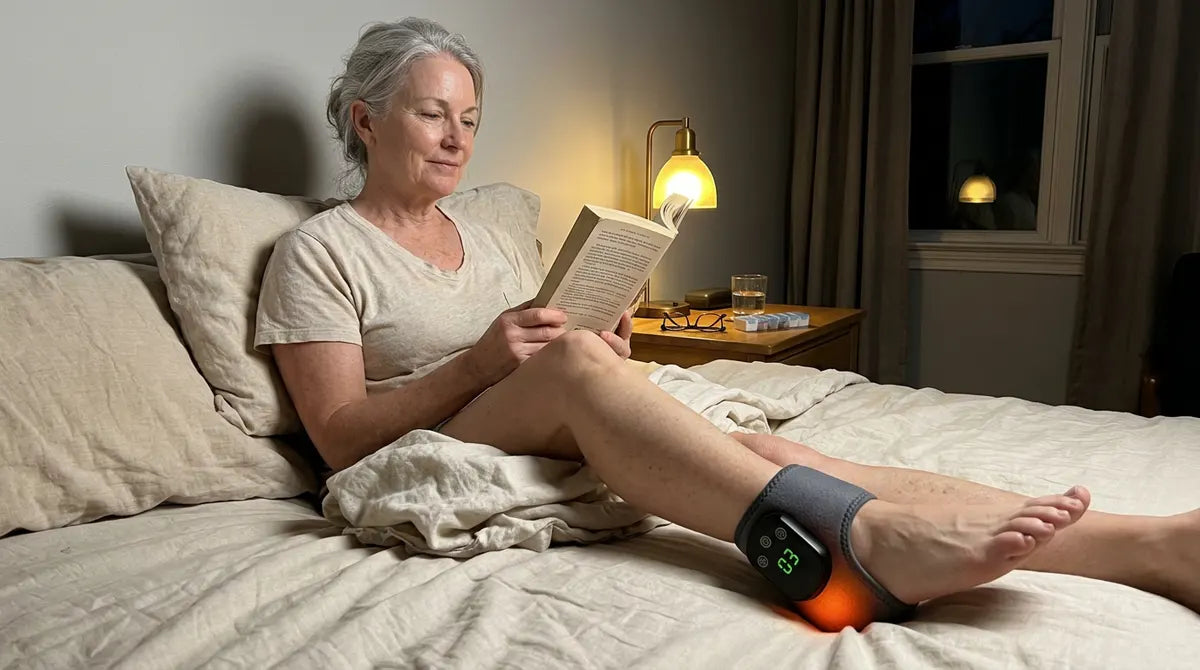
The device readers have written in about most is called the Soleus Foot Therapy System. It’s a soft neoprene wrap that delivers all three parts of Hemodynamic Therapy — targeted heat, rhythmic compression, and low-level neuromuscular activation — in one 20-minute session.
No clinic. No appointment. No driving. You sit on the couch.
- Wrap it around your foot, press one button, run for 20 minutes
- All three Hemodynamic Therapy modalities run together in the same session — three points of the loop, hit at once
- Cordless and rechargeable — use it anywhere at home
It’s not a prescription device. It’s a wellness product built around the same three-part combination clinic sessions use. Whether it’s right for you depends on your situation. But if you’ve been cycling through single-point treatments — orthotics, shoes, stretches, ice, cortisone — it’s at least worth reading the details.
See the reader rate ›What patients who’ve used it are reporting
“Three doctors told me I just had to live with it. I spent five years and more than six thousand dollars trying to prove them wrong. After two weeks using it I went from bracing on the bathroom counter every morning to just standing up. Last Saturday I walked the farmers market for two hours without sitting down. I kept waiting for it to be a fluke. It wasn’t.”
“I had two cortisone shots this year. My podiatrist said no more. I figured I was out of options. My daughter pushed me to try this. About three weeks in, my husband noticed before I did — he said ‘you used to wince when you stood up.’ I hadn’t realized I’d stopped.”
“I’m a nurse, on my feet all day. PT, orthotics, night splint — none of it held. This is the first thing that actually changed my mornings. I use it while I watch the news before bed. Simplest thing in the world.”
*Testimonials reflect the experiences of individual users. Individual results may vary. These are not guaranteed outcomes and are not intended as medical advice.

The takeaway
Both specialists we spoke with landed on the same point.
Foot pain doesn’t fail to resolve because patients haven’t tried hard enough. It fails because it’s a four-point loop. Single-point treatments — no matter how good — can’t hold that loop open long enough for the tissue to repair.
“If you’ve been stuck in the cycle, I’d encourage you to look at options that hit multiple points of the loop at once,” Dr. Caldwell said at the end of our call. “Not because any device is a guarantee. But because the math of the loop is real.”
Whether it’s a clinic program, an at-home device like Soleus, or something else — the category is what matters.
The era of “just manage it” — “better shoes,” “more stretching,” “this is just what 50 feels like” — may finally be ending.
Not because the treatments got better.
Because we finally started counting how many points of the loop we were breaking at once.
References
- American Academy of Orthopaedic Surgeons — “Plantar Fasciitis and Bone Spurs” (OrthoInfo).
- Martin R.L. et al. — “Heel Pain — Plantar Fasciitis: Revision 2014.” Journal of Orthopaedic & Sports Physical Therapy Clinical Practice Guideline.
- Cleveland Clinic — “Plantar Fasciitis: Symptoms, Causes & Treatment.”
- Mayo Clinic — “Plantar Fasciitis: Symptoms and Causes.”