Did You Know Poor Blood Circulation Can Make You Age Faster? — (And Why Your Skincare Routine Has Almost Nothing To Do With It)

Most women in their fifties do not know this. The single biggest driver of how visibly fast you age is not your skincare routine. It is your blood flow.
Vascular medicine has been quietly saying it for years. Dermatologists are starting to repeat it. Poor circulation can age you faster than almost anything else — and the place it begins is somewhere nobody is looking.
Two specialists agreed to walk us through the science. A board-certified dermatologist whose practice focuses on women over fifty. And a vascular medicine researcher whose lab studies how blood reaches the body’s connective tissue. She asked not to be named while this article was being prepared.
“If a woman in her fifties is frustrated her routine has stopped working,”1 the dermatologist told us, “the answer almost never lives on top of the skin. It lives underneath it.”
What follows is the version of the conversation we wish someone had handed us a decade ago.
Most women fight aging in the wrong place

The average anti-aging conversation happens entirely at the surface of the skin. Retinol. Peptides. Vitamin C. Microneedling. Lasers. Premium moisturizers. Each one targeting the visible result of aging — the wrinkle, the texture change, the dullness — and almost none of them addressing the upstream system that produced it.
“I see this every week,” the dermatologist said. “A patient walks in with a thousand-dollar shelf in her bathroom and a feeling that nothing is working anymore. She is right. It is not working as well as it used to. But she has been taught to ask the wrong question.”
The right question, both specialists agreed, is not which cream. It is which system is failing under the cream.
“You can’t out-cream a perfusion problem. The fibroblasts that build collagen need oxygen. They need nutrients. They get those from blood. If the blood isn’t arriving in the volume it used to, no topical product on earth changes the math.”
This isn’t a marketing position. It is what the cellular biology of skin actually says.
What is actually happening to your skin when circulation declines
The body has a delivery system. Arteries carry oxygen-rich blood from the heart, branch into smaller and smaller vessels, and ultimately end in the capillaries that feed every cell. Skin is fed by capillaries. Specifically, it is fed by a dense capillary network in the dermis — the layer underneath the surface where collagen is built and maintained.
The cells that build that collagen are called fibroblasts. They are entirely dependent on the oxygen and nutrients that capillaries deliver. When the supply slows, two things happen at once.

First, fibroblasts slow down their construction work. Without enough oxygen and nutrients arriving, they can’t synthesize collagen at the rate they used to. Second — and this is the part most women have never been told — under-perfused fibroblasts start producing enzymes that actively break collagen down. Researchers call them matrix metalloproteinases. They are part of what scientists describe as the senescence-associated secretory phenotype.2
The result: the cells that should be building your skin’s structure begin tearing it down instead.
The numbers researchers track
Sources: Frontiers in Pharmacology 2025; JMIR Dermatology 2024; American Journal of Pathology.
Where the decline starts: the feet
“If you want to know how aging is moving through someone’s body,” the dermatologist said, “don’t look at the face. Look at the feet.”
Feet sit at the end of the longest arterial run in the body. Blood pressure drops as it descends. By the time circulation reaches the toes, it is delivering at the lowest pressure of any tissue in the body. Feet are the first place women report cold extremities, slower nail growth, dry heels that no cream can resolve, and skin thinning — years before the same effects begin to appear above the knee.
“Vascular specialists call it the canary,” the researcher added. “The feet show, in the present, what is going to happen to the rest of the body in five to ten years.”

What restores circulation to tissue that has been starved
“The vascular research has been clear for two decades,” the researcher said. “Three interventions, delivered in the same session, are what it takes to meaningfully restore blood flow to peripheral tissue that has been chronically under-perfused.”
She gave us the name clinicians use for it informally: Hemodynamic Therapy.

1. Targeted heat (104–107°F). Triggers active vasodilation in the small blood vessels supplying peripheral tissue. Published studies have documented peripheral blood flow increases of up to 150% during sessions of this kind.3 The supply line that has been narrowing slowly for years opens up again.
2. Rhythmic compression. Mechanically pumps blood through tissue that has lost the muscle-pump support exercise normally provides. Compression alone is well-documented in venous circulation; combined with the next layer it becomes substantially more effective.
3. Low-level neuromuscular activation. Gentle electrical pulses contract the small muscles that move blood back toward the heart. EMS has been shown to increase venous flow velocity by 82–155% in clinical studies — in many cases more effectively than compression stockings alone.4
“One alone doesn’t do enough. Two doesn’t. Three at once is the threshold where the system actually starts delivering meaningful nutrients to tissue that’s been starved. Once that happens, the cells downstream — including the fibroblasts — have what they need to do their job again.”
Until recently, you could only get all three together inside a clinic. Two to three visits a week, $150 to $250 per session, equipment the size of a small filing cabinet, and an appointment calendar that fit no working woman’s life. Most women never even reached the door.
Over the last 18 months, that has begun to change.
Hemodynamic Therapy — all three modalities, delivered in a single 15–20 minute at-home session.
See the at-home protocol ›A reader-secured rate on the device built for this exact protocol
A small number of companies have begun commercializing Hemodynamic Therapy for at-home use over the last 18 months. The device our readers have written in about most is called the Soleus Foot Therapy System. It is the only at-home wrap we have seen that delivers all three Hemodynamic Therapy modalities — targeted heat, rhythmic compression, and low-level neuromuscular activation — in a single 15–20 minute session, on the body’s most chronically under-perfused tissue: the feet.
The Soleus Foot Therapy System
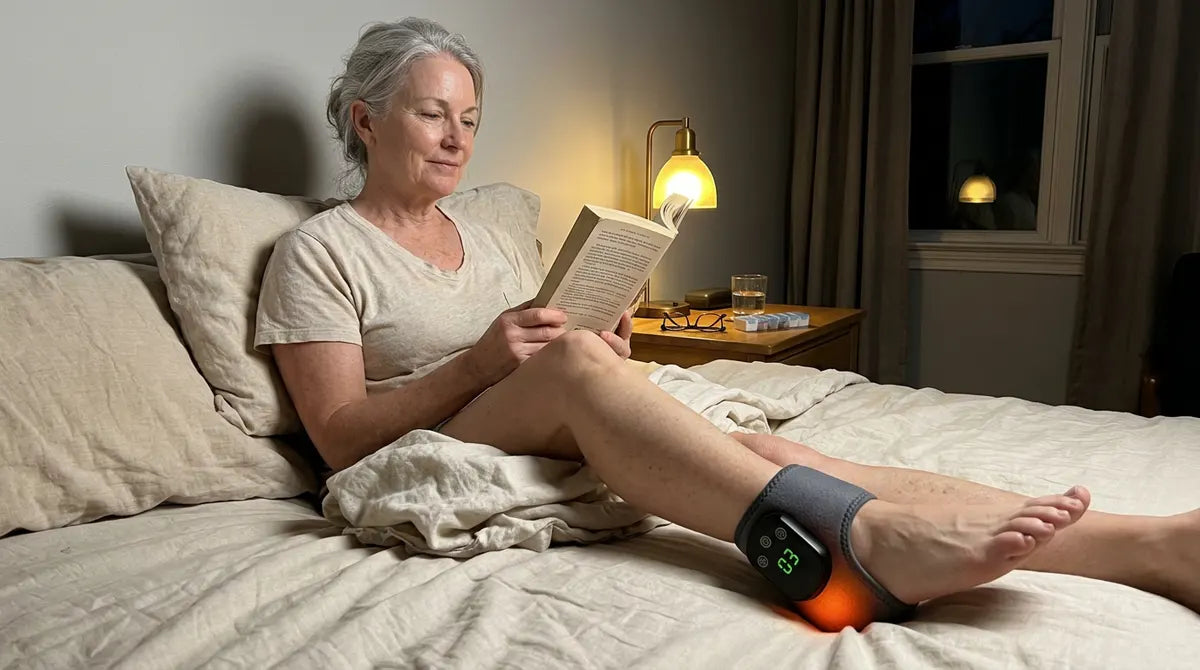
It is a simple neoprene wrap. You strap it around your foot, press one button, and let it run. All three therapies engage at once, on the part of the body where circulation declines first — and where the body’s aging signals first appear.
- One 15–20 minute session, lying down or in bed
- All three Hemodynamic Therapy modalities in the same session
- Cordless and rechargeable — use it anywhere at home
It is not a prescription device, and it is not a skincare product. It is a wellness device built around the same three-part combination clinic sessions have used for years — designed to address what creams and serums physically cannot reach. Whether it is right for you depends on your situation. But if you have been spending money entirely at the surface of the cascade, it is at least worth reading the details upstream.
See the reader rate ›What women using it are reporting
“I have spent more on skincare in the last decade than I want to admit. The thing nobody told me is that my feet had been quietly cold and dry for years and I just thought that was ‘getting older.’ After a few weeks of using this before bed, the warmth came back first. Then the cracked heels I couldn’t fix with any cream finally started to soften. I am not going to pretend my face looks twenty-five. It doesn’t. But I feel different from the inside, and I have stopped buying the next miracle jar.”
“My doctor mentioned circulation in passing at my last physical and I dismissed it because I felt fine. Three months in, I notice my nails are growing again. My toes aren’t the strange greyish color they were last winter. Whether any of that has anything to do with my face I cannot say. But I will say I stopped feeling like my body was quietly running out of steam.”
“I bought it because the science made sense to me. I was tired of being told the answer to every aging question was another serum. I use it for fifteen minutes while I do my evening reading. My husband, who notices nothing, asked me last month if I had started doing something different. That was enough proof for me to keep going.”
*Testimonials reflect the experiences of individual users. Individual results may vary. These are not guaranteed outcomes and are not intended as medical or anti-aging advice.
The takeaway
Both specialists landed on the same point.
The reason most women feel like their anti-aging routine plateaus in midlife is not that the products got worse. It is that the body’s own delivery system — circulation — quietly slows at the exact age the products are being asked to work harder. You cannot out-cream a perfusion problem. And the place where that perfusion problem becomes measurable first is also the place women have been least taught to look: the feet.
“If you have been chasing aging at the surface and getting smaller and smaller returns,” the dermatologist said at the end of our call, “I’d encourage you to look upstream. Not because any device is a guarantee. But because the math of the cascade is real.”
Whether it is a clinical program, an at-home device like Soleus, regular vigorous exercise, or some combination of all three — the category is what matters.
The era of treating aging only at the surface may finally be ending. Not because the creams got worse. Because we finally started asking what was actually feeding the cells underneath them.
References
- Bentov I., Reed M.J. — “The Effect of Aging on the Cutaneous Microvasculature.” Microvascular Research / NIH PMC.
- “Recent advances in dermal fibroblast senescence and skin aging.” Frontiers in Pharmacology, 2025.
- “Effect of heat stress on vascular outcomes in humans.” NIH PMC.
- “Effects on venous flow of transcutaneous electrical stimulation, neuromuscular stimulation, and sham stimulation on soleus muscle.” NIH PMC.
- “The Potential of Exercise on Lifestyle and Skin Function: Narrative Review.” JMIR Dermatology / NIH PMC.
- “Acute Effects of Whole-Body Vibration on Peripheral Blood Flow in Older Adults.” NIH PMC.