Podiatrist and Vascular Specialist Agree: This 4-Point ‘Tissue Lock’ Is Why Your Neuropathy Comes Back Every Night — (No Matter What You Try)

Our readers at FootHealth.Life keep asking the same question. Why does neuropathy come back every single night, even with Gabapentin?
Gabapentin worked for a few weeks. Then the dose crept up. Lyrica took the edge off — until the side effects became worse than the pain. Cymbalta gave you brain fog. Compression socks did nothing once you sat down. Warm soaks felt nice for ten minutes. And the burning, tingling, and numbness came right back the moment your feet hit the bed.
So we reached out to two specialists. They’ve spent their careers on opposite sides of this problem.
Dr. James Caldwell, DPM — a board-certified podiatrist with 22 years treating diabetic and peripheral neuropathy. And a vascular medicine researcher we consulted whose lab studies capillary perfusion in peripheral tissues. She asked not to be named while this article was being prepared.
“Neuropathy is one of the most stubborn conditions we see,”1 Dr. Caldwell says. “For most patients, it doesn’t really go away. It just gets worse at night.”
“The worst part? Most patients spend thousands of dollars chasing the sensation instead of the cause,” the researcher adds.
We asked both specialists the same question: what do clinicians actually know about why neuropathy keeps coming back — and why hasn’t that reached patients?
Their answer surprised us. It’s a pattern almost no exam room ever explains.
3 facts about peripheral neuropathy that explain why every treatment fails
Both experts started with the science.
Fact #1: Peripheral nerves have almost no blood supply of their own
“Your peripheral nerves don’t carry their own arteries. They depend on tiny capillaries in the surrounding tissue — capillaries roughly the diameter of a human hair — to deliver oxygen and clear inflammatory waste,”2 the researcher explains. “When those capillaries are damaged — by age, diabetes, chemotherapy, or chronic poor circulation — the nerves they feed slowly suffocate.”
That matters. The nerves don’t die. They go quiet. And quiet nerves don’t behave like silent ones. They misfire. They send phantom signals. They burn. They tingle. They feel numb.
This is the tissue starvation point of the lock.

Fact #2: The calf-muscle pump stops the second you sit or lie down
“This is the part almost nobody explains,” Dr. Caldwell says. “Walking is doing a lot more than moving you from A to B. Every time your calf muscle contracts, it squeezes the veins running through it and pumps blood back up your legs toward your heart.”
“You don’t notice this until it stops. The moment you sit down at the end of the day, that pump stops. Blood and fluid begin pooling in the lowest part of the body — your feet. The capillaries that were already struggling get even less circulation.”
So your stationary calves silently strangle your foot’s blood supply — exactly when the nerves need it most. This is the muscle guarding point of the lock.
“It’s why every neuropathy patient I see says the same thing: ‘It’s always worst at night.’ That’s not random. It’s mechanical.”
Fact #3: You can’t fix a four-point loop one point at a time
“Here’s the part that changes everything,” the researcher says.
“Neuropathy isn’t a single nerve injury. It’s a four-point loop. Pain signal looping. Muscle guarding. Blocked blood flow. Tissue starvation. Each one keeps the other three in place.”
Every treatment you’ve ever tried breaks exactly one of those four points. The other three put the loop right back within hours.
“You can’t pick a four-pin lock one pin at a time. For two decades, that’s what we’ve been asking patients to do. Try Gabapentin. Then compression socks. Then a vitamin. Then a topical. The loop doesn’t open until you hit three points in the same session.”
Already recognize this pattern in your own treatment history?
Skip to the solution ›Score every treatment you’ve ever tried against the 4-point loop
We asked Dr. Caldwell to walk us through the most common neuropathy treatments. One by one. Which point of the loop does each one actually break?
The pattern was striking.

“None of these are wrong,” Dr. Caldwell said when we showed him the table. “They all do something real. But a four-point loop doesn’t open with a one-point fix. You can see the math right here.”
“This is why I’ve changed how I talk to patients. The question isn’t ‘which medication is best.’ It’s ‘which combination hits multiple points of the loop in the same session.’ Those are very different questions. And only one of them has a useful answer.”
If your own score would be 1 of 4 across every treatment you’ve tried — here’s the at-home protocol that hits three points at once.
Skip to the solution ›The three therapies that open the loop — clinicians call it “Hemodynamic Therapy”
“The research on multimodal nerve and circulation recovery has been clear for more than fifteen years,” the researcher says. “Three treatments, delivered in the same session, are what it takes to hold the loop open long enough for the tissue to start repairing.”
She gave us the name clinicians use for it informally: Hemodynamic Therapy.
It’s three things, at once:
1. Targeted heat (104–107°F). Dilates the peripheral capillaries that have narrowed with age or disease. Heat alone, applied long enough, can open a vascular pathway that’s been collapsed for years.
2. Rhythmic compression. Mechanically substitutes for the calf-muscle pump that’s gone offline. Physically moves pooled fluid back up the leg and pushes fresh oxygenated blood into the foot.
3. Low-level neuromuscular activation. A very mild electrical pulse — far below muscle-contraction strength — gently re-stimulates dormant peripheral nerves. It doesn’t “shock” them. It reminds them.
“One alone doesn’t work. Two doesn’t. Three at once is the threshold. The fourth point — the pain signal — quiets on its own. Because nothing is holding it active anymore,” the researcher says.
Hemodynamic Therapy — all three therapies, delivered in a single 15-minute at-home session.
Skip to the solution ›What Mayo Clinic, Johns Hopkins, and others have published — and why this is finally reaching patients
The three-therapy combination isn’t new in the research world.
Research groups at Mayo Clinic, Johns Hopkins, and the American College of Sports Medicine have published extensively on multimodal soft-tissue and circulatory recovery over the past decade. They’ve documented how heat, compression, and electrical stimulation work together to restore peripheral perfusion and quiet misfiring nerves in patients with neuropathy.
Until recently, though, you could only get all three together in a clinic.
Two to three visits a week. $150 to $250 per session. Plus the insurance pre-approvals most people never cleared.
“Most of my patients couldn’t do that — financially, logistically, or because the feet that already burned were the same feet they’d need to drive with,” Dr. Caldwell says. “So they settled for one therapy at a time. Which is exactly why the loop never opened.”
That has started to change.
Over the last 18 months, a small number of companies have commercialized Hemodynamic Therapy for at-home use — designed around the same three-therapy combination clinicians have been using for years. One of them agreed to offer our FootHealth.Life readers a direct rate, without the typical clinic markup.
A reader-secured direct rate: the Soleus Foot Therapy System
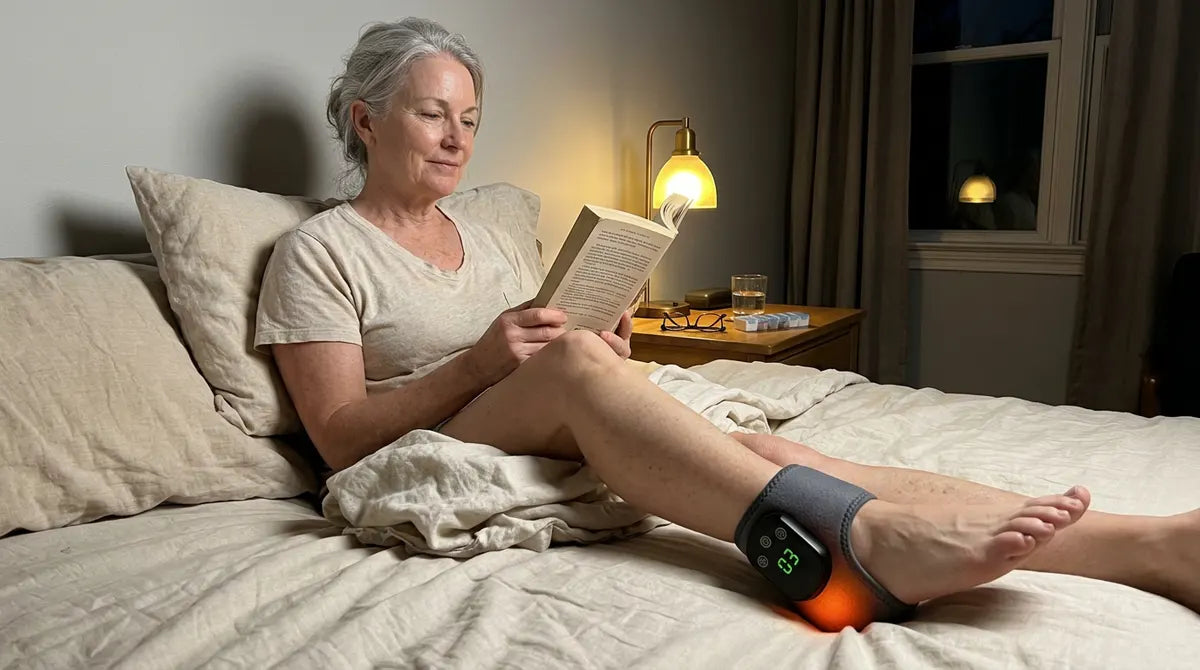
The device FootHealth.Life readers have written in about most is called the Soleus Foot Therapy System. It’s a cordless wrap that delivers all three parts of Hemodynamic Therapy — targeted heat, rhythmic compression, and low-level neuromuscular activation — in one 15-minute session.
No clinic. No appointment. No driving. You sit on the couch. You lie in bed.
- Strap it around your foot, press one button, run for 15 minutes
- All three Hemodynamic Therapy modalities run together in the same session
- Cordless and rechargeable — use it anywhere at home
It’s not a prescription device. It’s a wellness product built around the same three-part combination clinic sessions use. Whether it’s right for you depends on your situation. But if you’ve been cycling through single-point treatments, it’s at least worth reading the details.
See the reader rate ›What patients who’ve used it are reporting
“Two weeks in I noticed I was getting up once a night to use the bathroom instead of three or four times. By the end of week three the burning had stopped waking me up entirely. I’m 64. Type 2 diabetic for 19 years. Nothing else has touched it like this.”
“I almost didn’t try it. I’d already spent close to $2,000 on three different pairs of orthotic shoes, a TENS unit I never figured out how to use, and six months of Gabapentin that made me feel like a zombie. My wife told me to give the thirty-day trial a shot. I’m still wearing it every evening.”
“Honestly I expected this to be another gadget. The first night I felt the heat and thought ‘okay, that’s nice.’ By night seven I realized I’d slept through without waking up once. That hadn’t happened in maybe four years.”
*Testimonials reflect the experiences of individual users. Individual results may vary. These are not guaranteed outcomes and are not intended as medical advice.

The takeaway
Both specialists we spoke with landed on the same point.
Neuropathy doesn’t fail to resolve because patients haven’t tried hard enough. It fails because it’s a four-point loop. Single-point treatments — no matter how good — can’t hold that loop open long enough for the tissue to recover.
“If you’ve been stuck in the cycle, I’d encourage you to look at options that hit multiple points of the loop at once,” Dr. Caldwell said at the end of our call. “Not because any device is a guarantee. But because the math of the loop is real.”
Whether it’s a clinic program, an at-home device like Soleus, or something else — the category is what matters.
The era of “just manage it” may finally be ending. Not because the medications got better. Because we finally started counting how many points of the loop we were breaking at once.