
I Was on My Feet for Twenty-Two Years. The Swelling "Went Down by Morning." Until One Day It Didn't.
If your legs are heavier at the end of a shift than they were a year ago — and the mornings when everything feels normal are getting shorter — read this before you accept it as just getting older.
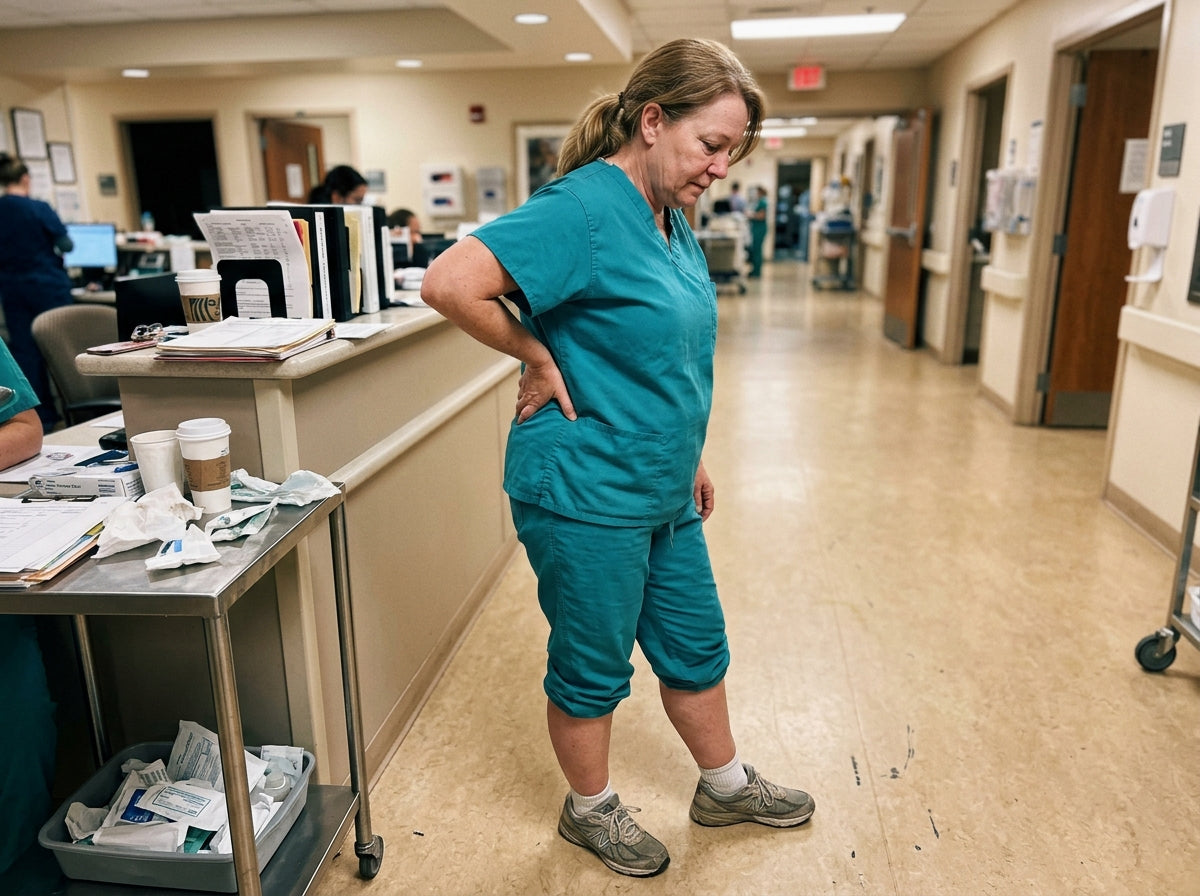
A Career Built on Standing — and Two Decades of Telling Myself It Was Fine
My name is Linda. I spent twenty-two years in the same job: on my feet, moving, standing, shifting weight from one foot to the other on concrete or tile for eight to twelve hours a day.
Nurse's aide first. Then a floor supervisor at a distribution center for the last eleven years.
I was strong for a long time. The kind of strong you earn by showing up, shift after shift, and not complaining.
Then the Past Few Years, Everything Changed
The shift itself wasn't the problem. I could still do my job. It was the end of the shift.
After hour seven or eight, my legs would start to feel like they were filling up with something. A heaviness. Not pain exactly — more like pressure that started at my ankles and moved up. By the time I pulled into my driveway, both feet were throbbing with every heartbeat.
I would take off my shoes and there it would be: a deep ring pressed into my sock line, right above the ankle. The kind of dent that takes a few seconds to spring back when you press your thumb into it.
I told myself it was normal. Every person on their feet all day gets this.
And the thing is — for a long time, I was right. I would wake up in the morning and my ankles would look normal again. The swelling had gone down overnight. I didn't think much about it.
That's when the story starts, really. Not when the swelling appeared. But when it stopped going away.
A Four-Minute Wrestling Match Just to Get My Socks Back On
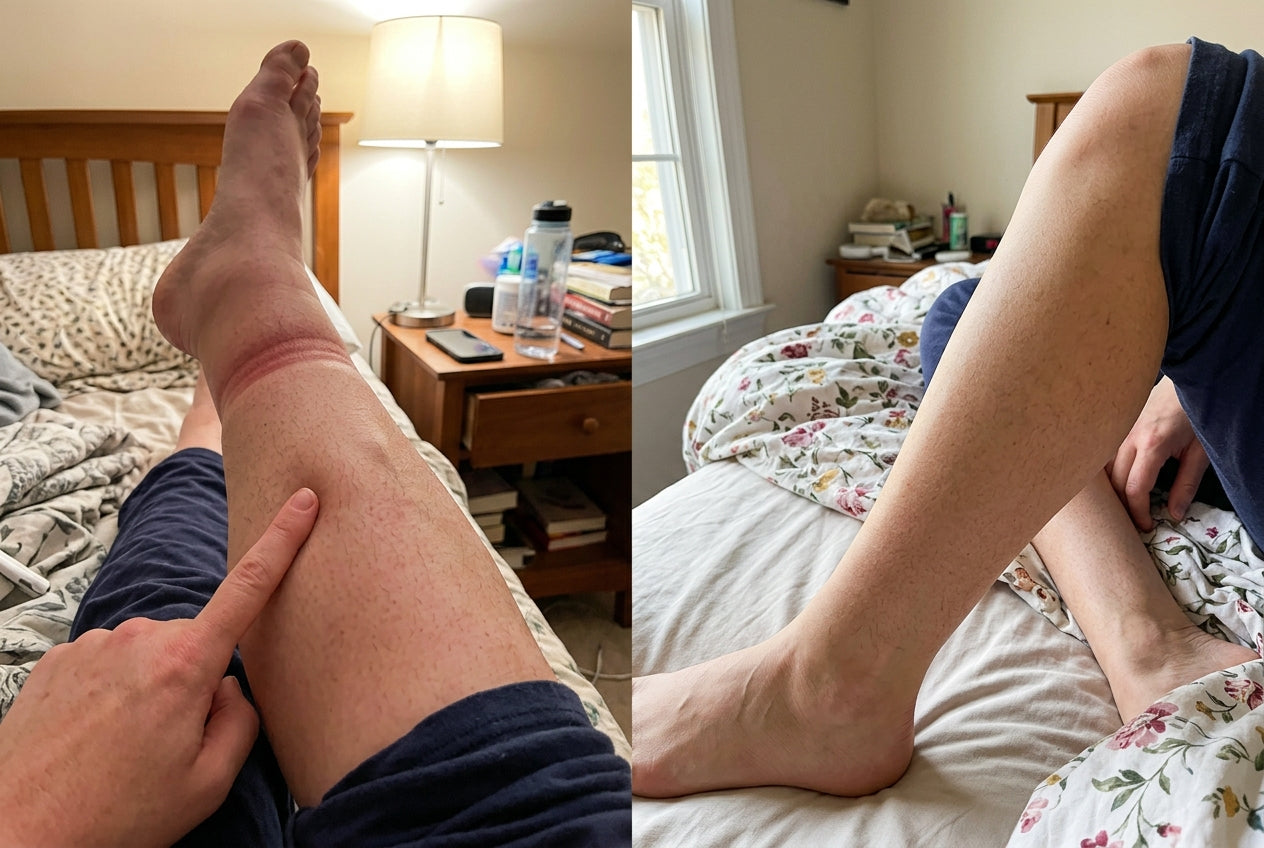
By year fifteen, the swelling was still there at lunch the next day. By year eighteen, it was there the morning after. The ring at my sock line had stopped being a temporary thing and started being just what my ankles looked like.
One evening I sat on the edge of the bed to put on a fresh pair of socks before my evening shift. My ankle was so tight and thick that pulling the sock up over it took real effort — the kind of effort that makes you hold your breath and lean into it.
Four minutes to get a sock on. I timed it because it seemed insane.
I told myself it was age. I told myself every woman in my family had legs like this by their fifties. I had accepted that this was my inheritance.
But deep down, something about the morning without swelling — how long it had been since I had one — kept sitting wrong with me.
Years of Trying. Same Legs at the End of Every Shift.
I want to be clear about what I tried. Because the list matters.
Compression socks. Three different pairs, two different compression levels. The tight ones made the shift almost unbearable by hour six. The looser ones helped the swelling look better but I still had the dent at my sock line every night. I wore them for two years.
Elevating my legs. I started doing this religiously after every shift. Fifteen minutes with my feet up on the couch, then thirty. The swelling came down faster. But it kept coming back the next shift, same as always.
Magnesium glycinate. A coworker swore by it. I took it for four months. It helped a little with the cramping at night. It did nothing for the daytime swelling or the heaviness.
A foam roller. I rolled my calves every morning and every night. My calves got a little looser. The swelling didn't change.
Epsom salt soaks. These felt nice. That's the kindest thing I can say.
A vein doctor. I finally went after my sister pointed out that my ankles looked "like Aunt Greta's did." The vein doctor told me my veins were "functioning within normal parameters" and that I should continue wearing compression and elevating. He said I had "some pooling consistent with prolonged standing." He didn't use the word problem. He used the word tendency.
I drove home and sat in the parking lot for a few minutes before going inside.
Seven years. At least four hundred dollars in compression socks and supplements and copays.
My ankles at the end of a shift looked exactly the same as when I started all of this.
The Conversation That Changed Everything
About six months ago, I was on break with Theresa. She and I have worked together for four years. Before the distribution center, she spent eighteen years as a vascular tech — the kind of technician who runs the imaging on veins and arteries.
Theresa had noticed me limping during the last hour of our shift. Not dramatically limping. Just favoring one foot. She asked me how long I had been doing that.
I laughed a little. I told her about the sock, the dent, the years of compression. I told her about the vein doctor.
She looked at me for a second and said something I had not heard from any of the eight professionals I had seen.
She said: "Has anyone ever talked to you about what standing still actually does to the pump?"
The Most Overlooked Thing Nobody in Eight Years Told Me
I asked what she meant.
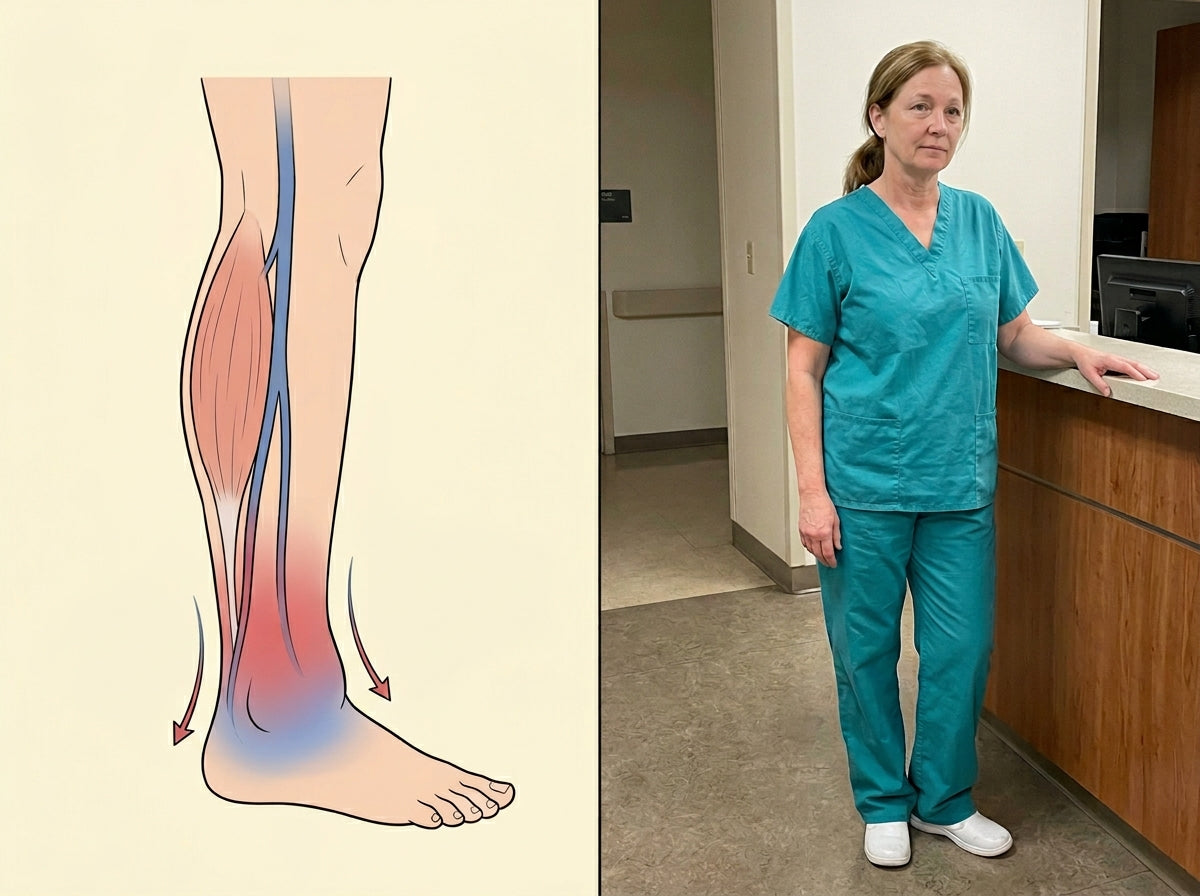
Theresa explained it simply. She said the calf isn't just a muscle — it's a pump. Cleveland Clinic actually calls it the body's "second heart." When the calf muscle contracts, it squeezes the deep veins in the lower leg and physically pushes blood back up toward the chest. Against gravity. Without that squeeze, blood and fluid sit in the lower leg and pool.
"Here's the part that gets people," she said. "Walking is fine. Walking actually keeps the pump cycling. But standing still? That's worse than walking. When you're standing, the muscle holds static. It doesn't contract. The pump goes quiet — and gravity has a full workday to do exactly what gravity does."
She paused and let that land.
"You've been standing on concrete for twelve hours a day for twenty-two years. That pump has been going quiet every single shift. Your vein doctor isn't wrong that there's pooling. He just didn't tell you why the pooling keeps happening no matter what you do from the outside."
If You Don't Wake the Pump, the Window Narrows
I asked Theresa what happens if you leave it.
She was quiet for a moment. Then she said: "You know Jenny from shipping?"
I did. Jenny had been with us for nine years and had done the same work I do. About a year ago she quietly moved to a desk role. She said it was a personal preference. But we all noticed the ankles.
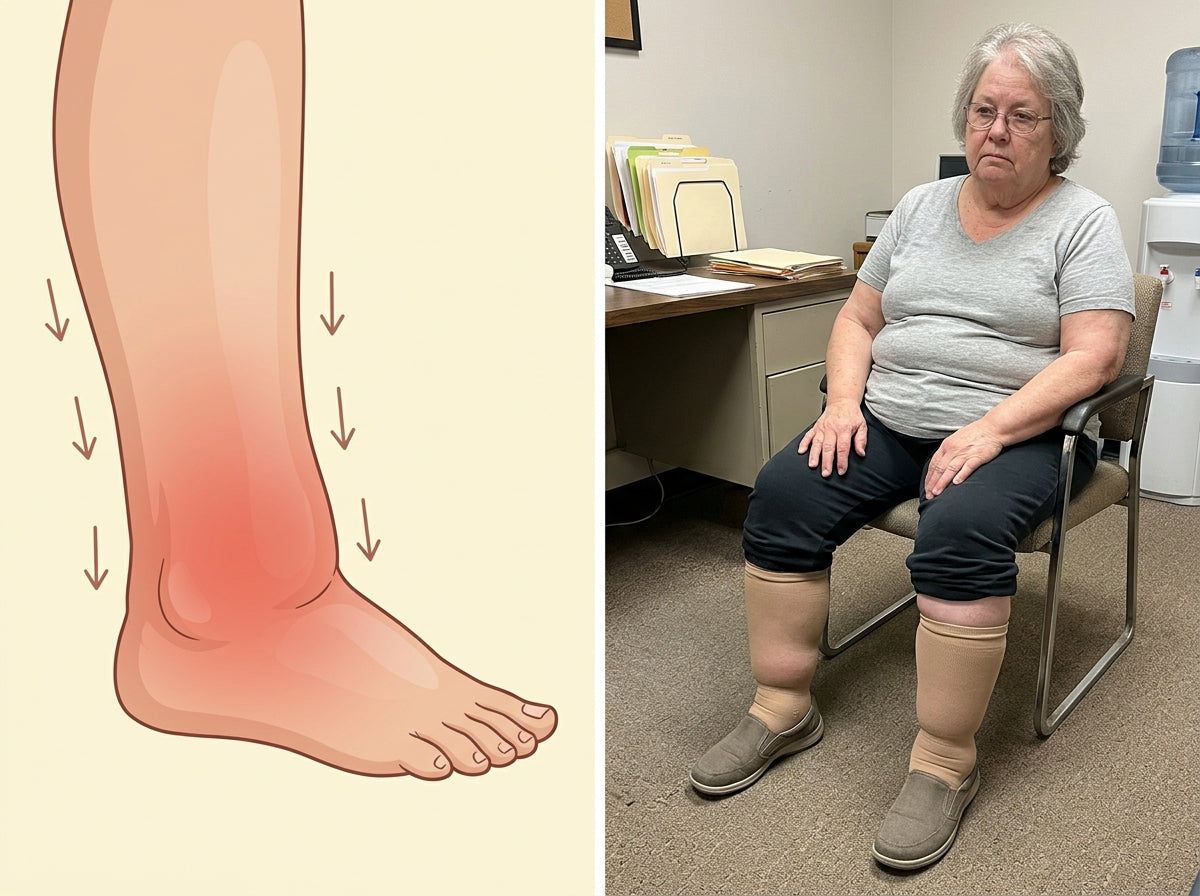
"The swelling that goes down by morning in year one," Theresa said, "goes down by lunch in year five. By year fifteen — sometimes it doesn't go all the way down anymore. The fluid has moved from the water to the tissue."
She used a phrase I haven't stopped thinking about since.
She said: "The window doesn't close all at once. It closes one shift at a time."
I thought about what gets handed down in families like mine. My mother's legs. My aunt Greta's ankles. I had always blamed genetics.
What gets handed down isn't only the veins — it's the standing. Generation after generation, the same job, the same concrete, the same quiet pump going offline shift after shift. Genetics loads the tendency; the standing pulls the trigger.
And then I thought about my job. About the next ten years. About whether I would be like Jenny, moving quietly to a desk role, or whether there was something I hadn't tried yet.
It's Called Calf Pump Reactivation
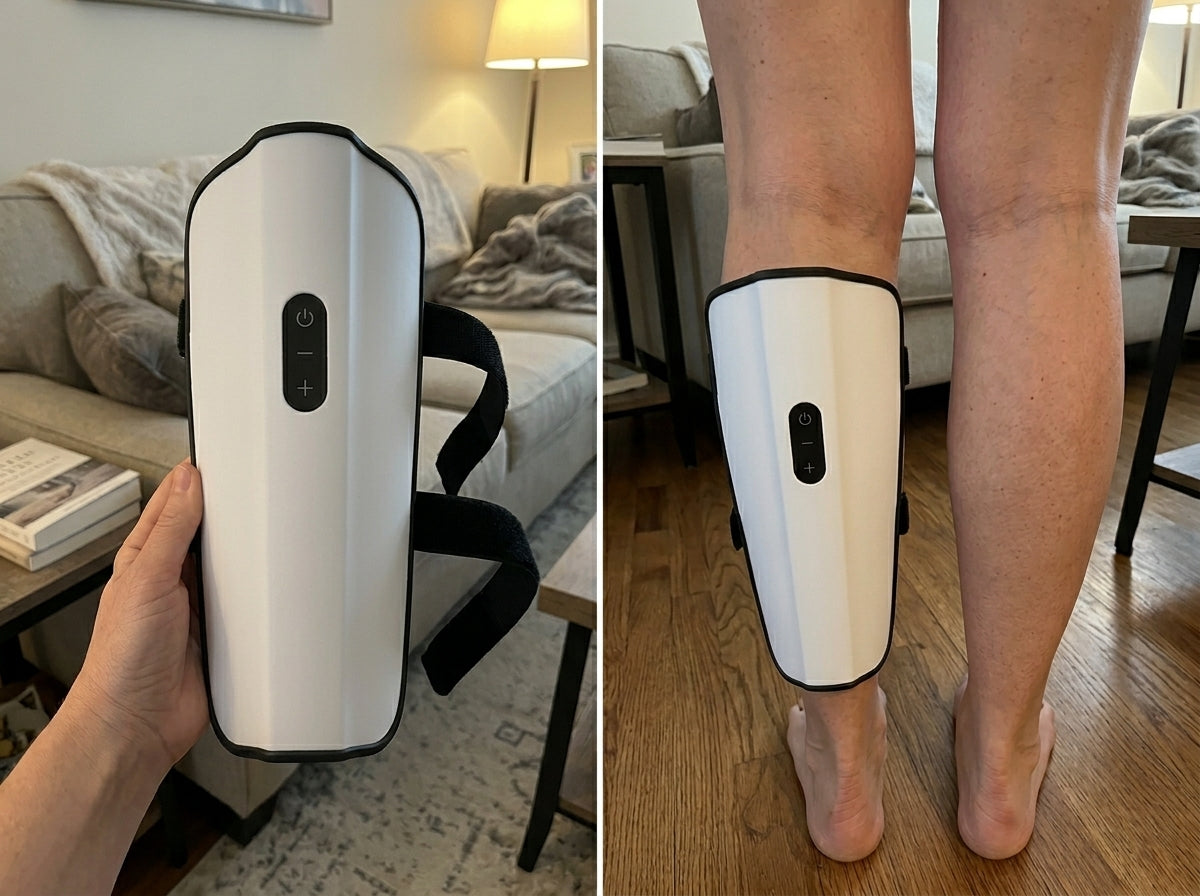
Theresa pulled out her phone and showed me what she had been using.
"It's not a compression sleeve," she said immediately, knowing what I was thinking. "Compression squeezes a passive muscle. This wakes up the muscle."
It is called the SOLEUS Calf Therapy Sleeve. A wearable wrap that goes around the calf — directly over the soleus muscle, where the pump lives. Wrap it on in about ten seconds. Sit on your couch. Let it run.
"What does it actually do?" I asked.
"Three things," she said. "In order."
The Three Things That Have to Happen Together
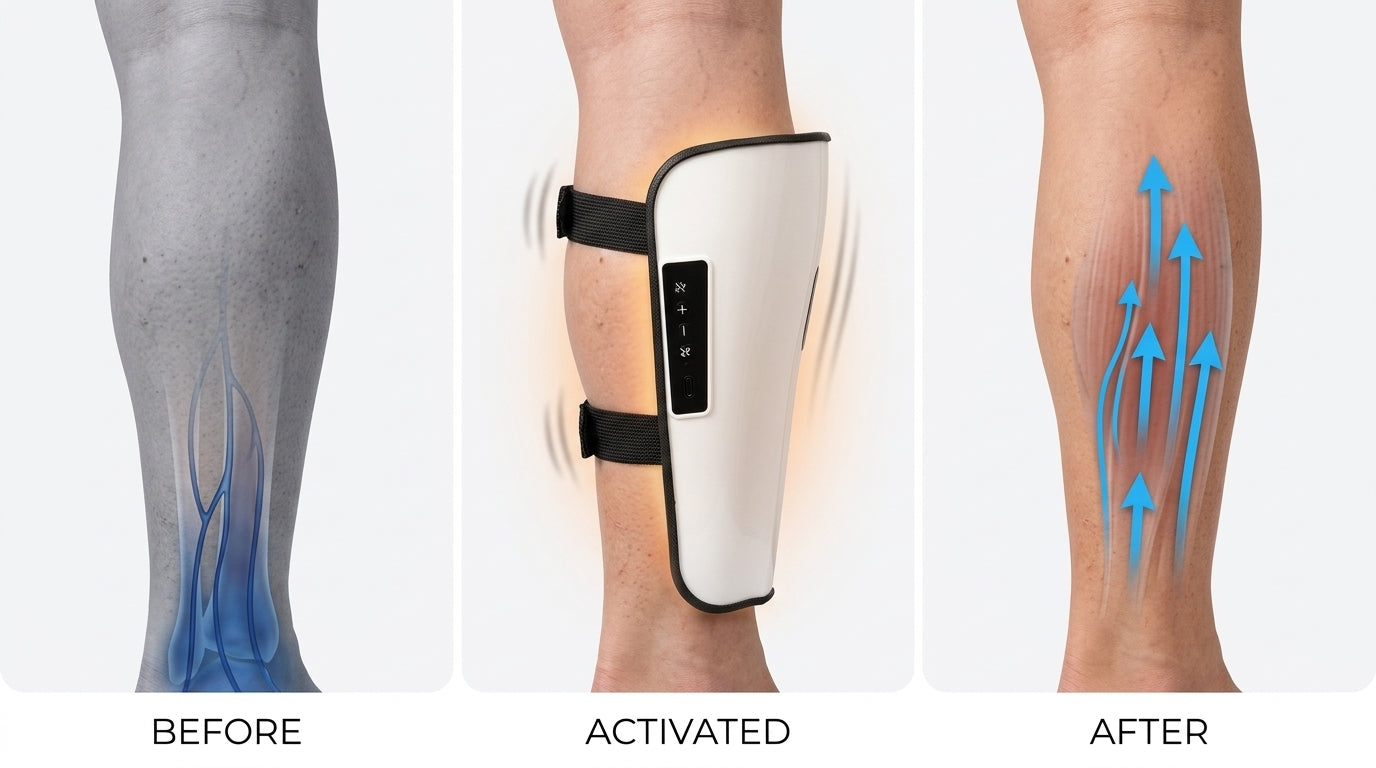
First: Therapeutic-range heat — to relax the muscle and open the vessels.
Theresa described it as a targeted warmth that holds in the 104–107°F range, directly on the tissue. Not a heating pad sitting on top. Wrapped around, held in place. "Your calf has been clenched and cold for twelve hours," she said. "You have to soften it before you can wake it."
Second: Vibration — to wake the dormant nerves.
The calf muscle doesn't contract on its own when standing still. The proprioceptive nerves — the ones that sense position and trigger the muscle to squeeze — go quiet during prolonged static standing. The vibration frequency is calibrated to stimulate those nerves specifically. "It's like ringing a doorbell," Theresa said. "You're telling the muscle: someone's there."
Third: EMS pulse — to actually contract the muscle.
This is the piece none of the other products had. Electrical muscle stimulation sends a controlled pulse directly into the soleus. The muscle actually contracts. The pump actually cycles. It is, as Theresa put it, "a walk for your calf without taking a step."
"REVITIVE does something similar," she said, "but through the soles of your feet. Indirect. Like pushing a door from ten feet away. This wraps directly around the muscle." She had tried both. She still had her REVITIVE. She no longer used it.
All three in sequence, both legs, while sitting on the couch after a shift. Fifteen minutes.
I thought: here we go again.
But I also thought about Jenny.
My First Session — and the Morning After
I ordered that evening. It arrived three days later. I put it on after my first shift back.
The heat phase surprised me. Within two minutes I could feel the tissue in my calf actually soften — like when you run warm water over a clenched fist. Then the vibration came in. And then the pulse.
I won't pretend it felt dramatic. It felt like my calves were doing something they had not done in a long time, under their own power.
That first morning: I woke up, put my feet on the floor.
The dent from the sock line was gone. Not lighter. Gone.
I stood in the kitchen and tried to find the familiar tightness in my ankles. It wasn't there at full strength. I pressed my thumb in. It sprang back almost immediately.
I texted Theresa: "I don't know what just happened but something did."
She texted back: "Give it three weeks. The pump needs time to remember how to work."
Before Calf Pump Reactivation — and Now

| Before | Now |
|---|---|
| Deep sock-ring dent every single night | Ankle looks the same morning and night most days |
| Four minutes to get a sock over a swollen ankle | Socks on, standing up, moving without thinking |
| Dreading the last two hours of every shift | Getting through the full shift and still standing straight |
| Watching Jenny's desk role and wondering when | My supervisor asked if I'd changed my shoes |
| Accepting my mother's legs as my future | Still making that decision — but it feels like a decision now |
I'm Just One Person — Here's What Others Have Said
Look. I am one person with one set of legs and one job. You should hear it from more than just me.
"I've been doing this for fourteen years and my legs swell. I've tried everything on the shelves. Nothing touched the actual swelling until I stopped trying to squeeze from the outside and started waking the muscle up from the inside." — kejRN
"I hate how throughout the day my ankles get thicker. I thought I was just built this way. My vascular nurse friend told me the same thing Theresa told Linda. It's the standing, not just the body."
"After the third day I started to get painful throbbing. My breath would quicken by the end of the shift. I literally limped home. Now I use the sleeve after every shift. The throbbing is there some nights. But it's not the same animal." — AppropriateWay4901
And one from a vein doctor that Theresa forwarded to me after I told her my experience:
"The onset of symptoms is so insidious that you don't recognize that the heaviness, fatigue, cramps and swelling are all symptoms." — Dr. Dvora Nelson, vein specialist
That last one I have read probably twenty times. Because it is exactly what happened to me. I normalized the symptoms one by one until the window had been closing for years before I looked up.

I want to be honest with you: I cannot promise it will work for you. My legs are my legs. Yours are yours.
The Math Is Not Complicated
Here is what I had spent on the same problem before I found this:
- Compression socks (three rounds): ~$140
- Magnesium, supplements: ~$80
- Vein doctor copay: $45
- PT visit x 2: $80
- Foam roller, Epsom salt, random topicals: ~$60
Total: roughly $405. For no lasting change.
The SOLEUS Calf Therapy Sleeve: $79.99.
A single unit, both legs, USB-C rechargeable, no wires, no setup, no monthly subscription. You wrap it on. You sit down. It does the work.
No free shipping on the single unit — they're upfront about that. But compared to $405 and a vein doctor telling me my pooling was within "normal parameters," eighty dollars for something that actually wakes the pump felt straightforward.
If Your Legs Have Been Going Down by Morning — But "Morning" Has Been Getting Later
You have three options.
Option one: Keep doing what you're doing. Compression socks, elevation, maybe a new supplement. You already know how that ends — you've been living that ending.
Option two: Wait. See if the window closes a little more on its own.
Option three: Try Calf Pump Reactivation for thirty days. Wake the pump. See if your ankles look different in the morning.
I am not telling you this is a cure. I am not telling you it will work.
I am telling you that my sock goes on in thirty seconds now. I am telling you that the morning when everything feels normal has come back. And I am telling you that Theresa — who spent eighteen years watching legs fail — uses it on her own calves after every shift.
That is all I know. What you do with it is up to you.
SOLEUS™ Calf Therapy Sleeve is a wellness device intended to support healthy circulation and comfort, not a medical treatment. Individual results may vary. Statements regarding this product have not been evaluated by the FDA. This is not intended to diagnose, treat, cure, or prevent any disease. If you are managing a serious medical condition or are pregnant, consult your physician before use. This is my personal experience. I am not affiliated with SOLEUS. Results depicted are not typical and individual outcomes will differ based on activity level, physiology, and consistency of use.